TWO:Since mankind generally, suspicious always of the language of reason, but ready to bow to that of authority, remain unpersuaded by the experience of all ages, in which the supreme punishment has never diverted resolute men from committing offences against society; since also they are equally unmoved by the example of the Romans and by twenty years of the reign of the Empress Elizabeth of Russia, during which she presented this illustrious example to the fathers of their people, an example which is at least equivalent to many conquests bought by the blood of her country¡¯s sons, it is sufficient merely to consult human nature itself, to perceive the truth of the assertion I have made.
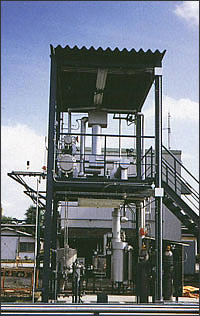
Great attention is recently being paid to global environmental issues, and it is now conceivable that companies will need to treat used solvents themselves. In consideration of this kind of social issue, we have developed a “membrane separation type solvent dehydration system,” which uses a polyimide membrane with superior dehydration properties developed by Ube Industries, Ltd. in combination with our own distillation and concentration technology that has resulted in solvents being more easily recovered.
THREE:It is well known that Lord Tenterden refused ever to sit again in the House of Lords if the Reform Bill became law, and that he predicted that that measure would amount to the political extinction of the Upper House. As regards the history of our criminal law Lord Tenterden was right, for the period of long pauses had passed away, and rapid changes were made with but short intervals of breathing-time. From the year the Reform Bill passed the school of Beccaria and Bentham achieved rapid successes in England. In 1832 it ceased to be capital to steal a horse or a sheep, in 1833 to break into a house, in 1834 to return prematurely from transportation, in 1835 to commit sacrilege or to steal a letter. But[67] even till 1837 there were still 37 capital offences on the statute-book; and now there are only two, murder and treason. Hanging in chains was abolished in 1834; the pillory was wholly abolished in 1837; and the same year Ewart, after many years¡¯ struggle, obtained for prisoners on trial for felony the right (still merely a nominal one)[39] of being defended by counsel.[37]
- 1Under the distillation system, even in case of azeotropic solvent compositions, this system which remove water vapor by the polyimide membrane will easily dehydrate.
- 2In comparison with the distillation system, it significantly saves on use of steam.
- 3Dehydration can be performed through merely supplying evaporated vapor to the membrane module and maintaining the differential pressure between the permeable side and the impermeable side.
- 4Solvent purity of 99.9% or more can be achieved by carrying out dehydration with a polyimide membrane only.
- 5The polyimide membrane has superior heat and solvent resistance. Therefore, the vapor permeation system reduces contamination of the membrane and thus extends its life.
THREE:
The aromatic polyimide membrane is highly permeable to water vapor but less permeable to vapors of organic compounds such as alcohol etc.
THREE:Lord Ellenborough, on the last day but one of May 1810, appealed to their lordships to pause, before they passed the Shoplifting Bill and gave their assent to the repeal of a law which had so long been held necessary for the security of the public. No one, he insisted, was more disposed than himself to the exercise of clemency, but there was not the slightest ground for the insinuations of cruelty that had been cast on the administration of the law. If shoplifting did not require the penalty of death, the same rule would have to apply to horse- and sheep-stealing; and, in spite of all that was said in favour of this speculative humanity, they must all agree, that prevention of crime should be the chief object of the law, and that terror alone could prevent the crime in question. Those who were thus speculating in modern legislation urged that punishment should[63] be certain and proportionate; but he could satisfy the House that any attempt to apply a punishment in exact conformity to the offence would be perfectly ludicrous. He had consulted with the other judges, and they were unanimously of opinion that it would not be expedient to remit this part of the severity of the criminal law.[38] He therefore entreated them to pause.
- 1 Recovery of the detergent solvent Recovery of the cleaning solvent such as electronic parts industry, precision instrument industry.
- 2Solvent recovery and the refinement Solvent recovery and the refinement such as chemical industry, an industry of medical supplies, food industry, the fermentation industry.
THREE: Thefts without violence should be punished by fine. He who enriches himself at another¡¯s expense ought to suffer at his own. But, as theft is generally only the crime of wretchedness and despair, the crime of that unhappy portion of mankind to whom the right of property (a terrible, and perhaps not necessary right[67]) has left but a bare subsistence; and as pecuniary penalties increase the number of criminals above the number of crimes, depriving the innocent of their bread in order to give it to the wicked, the fittest punishment will be that kind of servitude which[214] alone can be called just, namely, the temporary servitude of a man¡¯s labour and person for the compensation of society, the personal and absolute dependence due from a man who has essayed to exercise an unjust superiority over the social compact. But when the theft is accompanied with violence, the punishment also should be a combination of corporal and servile punishment. Some previous writers have shown the evident abuse that arises from not distinguishing punishments for thefts of violence from those for thefts of cunning, thus making an absurd equation between a large sum of money and the life of a man. For they are crimes of a different nature; and in politics, as in mathematics, this axiom is most certain, that between heterogeneous quantities the terms of difference are infinite; but it is never superfluous to repeat what has hardly ever been put into practice. Political machinery more than anything else retains the motion originally given to it, and is the slowest to adapt itself to a fresh one.
Acetone, ethanol, methyl ethyl ketone, butanol, isopropyl alcohol, ethyl acetate, methyl isobutyl ketone, others (including hexane and toluene).
